The best folding mobility scooter for travel and small trunks
I'm Diane, and over the years I've helped a lot of people get a scooter into the back of a car for the first time. Almost always the same wish comes up: something that folds small, lifts without a fight, and goes wherever the family goes. The trouble is that the word "folding" gets stretched to cover machines that really only come apart into pieces. On this page, folding means the scooter collapses as one unit, often by a button on a remote, and lifts as a single shape. I'll flag clearly where a model only disassembles instead, because the two behave nothing alike once you're standing at the trunk.
There are only a handful of true folders, and they load very differently from the take-apart kind. Below I'll show you which scooters genuinely fold, which ones break into light pieces, and how to match either approach to your car, your strength, and your travel plans. My top pick for true folding and for flying is the EV Rider Transport AF+, though it suits some riders and not others, and I'll spell out exactly where it falls short so your choice is an informed one.
Folding vs. disassembly: what the word really means
This is the single most useful thing I can teach you, so I'll slow down. A genuinely folding scooter collapses into one compact shape and stays in one piece. You roll it, fold it, and lift the whole thing as a unit. The best of these auto-fold, meaning a motor does the bending for you when you press a button on a remote. You barely touch it until it's time to lift.
A disassembling scooter works the other way. It separates into several chunks: the seat, the battery pack, the front section, and the rear with the heavy motor. Companies call these "travel" scooters, and many people file them alongside folding models, but you're loading four or five separate parts rather than one folded shape.
Two things flow from that difference. With a folder you lift the full weight once. With a disassembling scooter you lift several lighter pieces, though one of them, usually the rear motor section, stays fairly heavy, and that heaviest piece is the figure your back actually feels. The second factor is fuss. Pulling parts apart and clicking them back together at every stop wears thin, especially when your hands aren't what they once were. For the model-by-model breakdown of why the heaviest piece beats the spec-sheet total, see my weight and size guide.
A simple way to choose: when you want the least handling and the smoothest airport experience, lean toward a true folder. When you want the lightest individual lift and don't mind a few clicks of assembly, a disassembling travel scooter can be a smart, cheaper route. Both are valid. My only goal is that you don't discover the difference in a parking lot.
My top pick for true folding: EV Rider Transport AF+
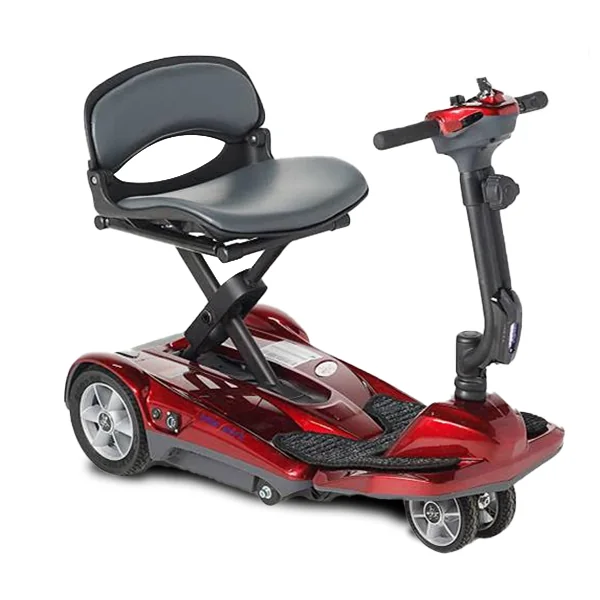
If you came here wanting a scooter that genuinely folds, this is the one I point people to first. The EV Rider Transport AF+ auto-folds by remote. Press the button, the frame collapses on its own, and you're left with one compact unit to load. At about 49 lbs it's the lightest scooter on my whole list, and it goes into the trunk in a single piece rather than as a pile of parts. For anyone who travels solo or has a helper who isn't strong, that one-piece handling changes everything.
It also runs on a lithium battery that is approved for airlines and cruises, which is the other reason it earns the folding crown. Most scooters can't fly. This one is built specifically for it. The turning radius is a tight 31 in, so it threads through restaurants and hotel rooms without a three-point turn.
The limits are real, so I'll name them plainly. The weight capacity is 250 lbs, the lowest of any scooter I cover here, which rules it out for heavier riders. Top speed is 3.8 mph, the slowest in this group, and range runs up to 10 mi, plenty for an airport, a mall, or a day of sightseeing but short for long hauls. At roughly $2,250 it's also the priciest folder on the page. That money buys the auto-fold convenience and the airline approval. Those two features are exactly why it's worth it to some riders and overkill to others, so keep reading if neither is driving your search, because you can spend less. The full breakdown is in my EV Rider Transport AF+ review.
Lighter on your back: disassembling travel scooters worth considering
When a true folder is more than you need, or more than you want to spend, the take-apart travel scooters make excellent alternatives. Ignore the total weight with these and ask one question: how heavy is the single heaviest piece I'll lift? That figure is what reaches your back at the car.
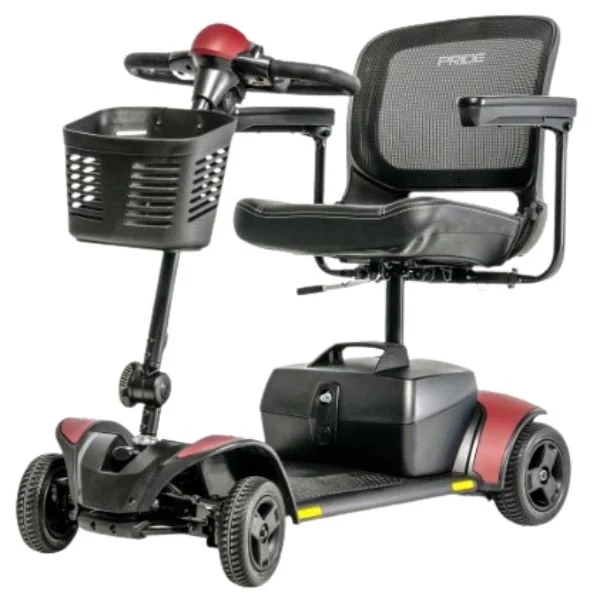
The Pride Go-Go Elite Traveller 2 is my favorite of this style. It splits into five pieces, and the heaviest comes in around 35 lbs, a manageable lift for most people. The Pride iTurn feature gives it a remarkably tight 37 in turning radius, nearly as nimble as the folding EV Rider. With the 18 Ah battery it covers up to 13.8 mi, more real-world range than the EV Rider delivers, and it holds up to 300 lbs. At around $1,099 it costs roughly half of the auto-folder. You handle the assembly yourself at each stop, but the pieces are light and the clicks are simple. My full notes are in the Go-Go Elite Traveller 2 review.
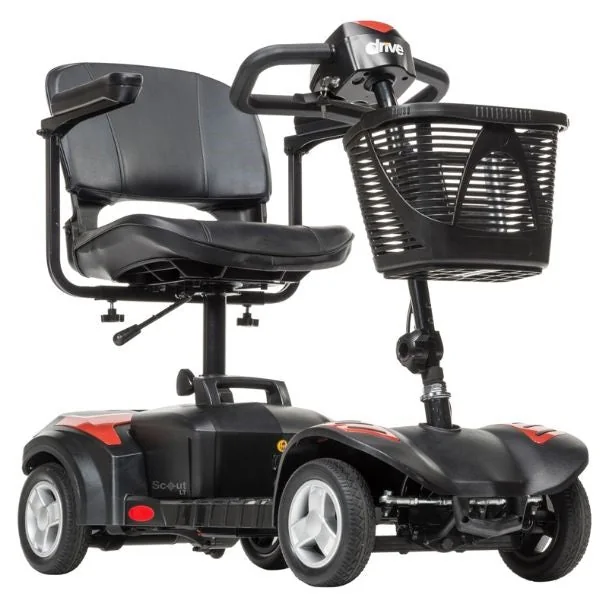
The Drive Medical Scout is the budget choice at about $849, a sensible and stable little scooter. It breaks into pieces and runs up to 9 mi on the standard battery, or roughly 15 mi if you add the extended battery. It holds 300 lbs and rides on flat-free tires, so punctures never enter the picture. Two caveats stand out. The total weight is about 94 lbs spread across the parts, and the turning radius is a wide 53.75 in, so it needs more room to come around than the Pride or the EV Rider. That wide turn becomes a nuisance in tight indoor spaces. As a budget take-apart scooter, though, it earns its keep. See the Drive Medical Scout review for the full picture.
How my folding picks compare
Here's the short version side by side. The column that matters most for your back is the heaviest lift, not the total weight.
| Scooter | Folds or disassembles | Heaviest lift | Range | Capacity | Flies? | Price |
|---|---|---|---|---|---|---|
| EV Rider Transport AF+ | Auto-folds, one piece | About 49 lbs (whole unit) | Up to 10 mi | 250 lbs | Yes, airline approved | ~$2,250 |
| Pride Go-Go Elite Traveller 2 | Disassembles, 5 pieces | About 35 lbs | Up to 13.8 mi | 300 lbs | Generally no | ~$1,099 |
| Drive Medical Scout | Disassembles, pieces | Heaviest piece of ~94 lbs total | Up to 9 mi (15 with extended battery) | 300 lbs | Generally no | ~$849 |
The EV Rider asks for one 49 lb lift but spares you any assembly and lets you fly. The Pride hands you five pieces, yet the heaviest is only about 35 lbs and you keep real money in your pocket. The Drive Scout costs the least, while its wide turn and spread-out weight make it the least convenient of the three. No single answer fits everyone. The right pick comes down to your body and your trips. To weigh these against other travel options, my best travel mobility scooter roundup goes wider, and the per-piece numbers live in the weight and size guide.
Flying with a scooter: what actually clears the gate
Flying is where the folding question gets serious. Airlines set strict rules about scooter batteries, and those rules differ from one carrier to the next. In broad terms, lithium batteries are the ones designed to travel, while lead-acid batteries are heavier and usually stay home. The EV Rider Transport AF+ stands out precisely because its lithium battery is approved for airlines and cruises, and because it folds into one piece that gate agents and baggage handlers can manage.
None of this is a guarantee, though. Battery rules change, and individual airlines set their own limits on watt-hours and on how the battery must be packed or carried. Before you book, call the airline directly, tell them the exact scooter and battery you have, and get the requirements in writing where you can. A few minutes on the phone beats a scooter turned away at the counter.
One practical note rounds this out. Even an airline-approved folding scooter usually needs its battery handled a certain way, sometimes removed and carried into the cabin. When batteries weigh on your decision, my mobility scooter battery guide walks through lithium versus lead-acid in plain language so you know what you're carrying aboard.
Will it fit your trunk? A few questions to ask first
Before any scooter wins you over, measure your trunk. Really measure it, with a tape, including the opening rather than just the cargo floor. A scooter can look small in a photo and still refuse to clear a narrow trunk lip.
Then work through these questions:
- Who lifts it? When the lifting falls to you and your strength is limited, a disassembling scooter with light pieces may beat a heavier one-piece folder. When a helper does the lifting, a single folded unit keeps things simple.
- One piece or several? A folding scooter goes in whole, so you need trunk space for the full folded shape. A disassembling scooter goes in as parts, which can tuck into odd spaces but means more bending and clicking.
- How often will you load it? Daily loading rewards the least fussy option. A scooter you load twice a year can tolerate more assembly.
- Do you ever fly? A yes narrows the field hard toward the EV Rider and its airline-approved battery.
Turning radius and the weight of the heaviest piece tell you more about daily life with a scooter than the top speed printed on the box. A scooter that turns tight and lifts easy will get used. One that turns into a wrestling match sits in the garage. Still deciding between styles? My how to choose a mobility scooter guide and my best lightweight mobility scooter picks both carry the question further than I can here.
Compare our tested picks side by side, with real specs, photos and honest pros and cons.
Independent and reader-supported. Some links in our reviews are affiliate links that never change our rankings. How we test.
Frequently asked questions
What's the difference between a folding and a portable scooter?
A folding scooter collapses into one compact shape and stays in one piece, and the best ones auto-fold by remote so a motor does the work. A portable or travel scooter usually disassembles into several pieces instead. Both transport more easily than a full-size scooter, but they handle differently. With a folder you lift the whole unit once, like the roughly 49 lb EV Rider Transport AF+. With a disassembling model you lift several lighter pieces, and the heaviest of those, often the rear motor section, is the figure that lands on your back.
Can I take a folding mobility scooter on an airplane?
Some folding scooters are built for it, though no scooter is guaranteed to clear the gate. As a general rule, lithium batteries are the ones designed to travel and lead-acid batteries usually are not. The EV Rider Transport AF+ stands out because its lithium battery is approved for airlines and cruises and it folds into one piece. Even so, airline rules are strict and vary by carrier, so call your airline directly before booking, tell them the exact scooter and battery, and confirm the requirements. I never promise a battery will be accepted.
Is the heaviest piece more important than the total weight?
Yes, and it catches a lot of people out. On a disassembling scooter you never lift the total weight at once. You lift the pieces one at a time, so the heaviest single piece is what reaches your back. The Pride Go-Go Elite Traveller 2 splits into five pieces with the heaviest around 35 lbs, manageable for many people despite the part count. When you compare scooters, look past the total and find the heaviest individual piece you'll actually handle. My weight and size guide lays out those per-piece figures model by model.
Which folding scooter should I pick if I'm on a tighter budget?
When a true auto-folding scooter runs past your budget, the disassembling travel scooters are excellent value. The Pride Go-Go Elite Traveller 2 at around $1,099 gives you a light heaviest piece, a tight turn, and good range. The Drive Medical Scout at about $849 is the budget choice, stable and dependable, though it has a wider turning radius and spreads its weight across larger pieces. Neither flies the way the EV Rider does, yet both cost considerably less and load into most trunks once you've measured.
Does Medicare cover a folding mobility scooter?
I focus on the equipment, not the paperwork, so take this as a starting point rather than coverage advice. Medicare Part B may help with a power mobility device in some cases, but only with a doctor's prescription showing a medical need for use inside your home, and the documentation rules are strict. Travel and folding convenience on their own usually don't qualify. The honest path is to talk with your doctor about whether you meet the criteria and what paperwork is required. More detail sits in my guide on whether Medicare covers mobility scooters, and my testing methodology spells out where my advice stops and a clinician's begins.

I spent years helping older adults choose and fit mobility scooters, and I test these myself. I write every review and guide here, and I rank by what actually keeps a rider safe and independent, not by who pays the most. I am not a doctor. How we test →